Yard trees at a glance
UF/IFAS researchers counted which trees were still standing after a series of Florida hurricanes and asked experts to rate each species. The groups and percentages below come from FOR119 (Selecting Coastal Plain Species for Wind Resistance, revised August 2026) and, for queen palm and the cabbage palm's group, its companion FOR120 for tropical and subtropical species (revised October 2026). A tree leaning at less than 45 degrees from the ground counted as down (both checked Nov 9, 2026).
| Tree | UF/IFAS group | Share still standing |
|---|---|---|
| Live oak | Highest | 91% after Ivan; 78% after Charley and Andrew |
| Southern magnolia | Highest | 92% after Ivan |
| Crape myrtle | Highest | 84% after Ivan |
| Cabbage palm | Highest | 80 to 100% across the storms surveyed |
| Slash pine | Medium-low | 72% after Ivan |
| Longleaf pine | Medium-low | 59% after Ivan; 57% after Charley |
| Camphor | Medium-low | 90% after Charley |
| Laurel oak | Lowest | 77% after Ivan |
| Queen palm | Lowest | 74% after Jeanne; 69% after Charley |
The groups draw on expert ratings as well as the counts, so a percentage alone doesn't set the rank. A tree in a high group can still fail if it's decayed, crowded or damaged at the roots.
Live oak and laurel oak
These two oaks sit at opposite ends of the wind table. UF/IFAS's fact sheets give live oak a lifetime measured in centuries and "very good wind resistance," while laurel oak lives 50 to 70 years and its trunk and big limbs "often hollow from decay and wood rot." Live oak's challenge is size: 60 to 80 feet tall and 60 to 120 feet wide, with roots that in time lift sidewalks and driveways (fact sheets ENH-722 and ENH-707, revised December 2018; checked Nov 9, 2026). The oak guide covers both in detail.
Cabbage palm and queen palm
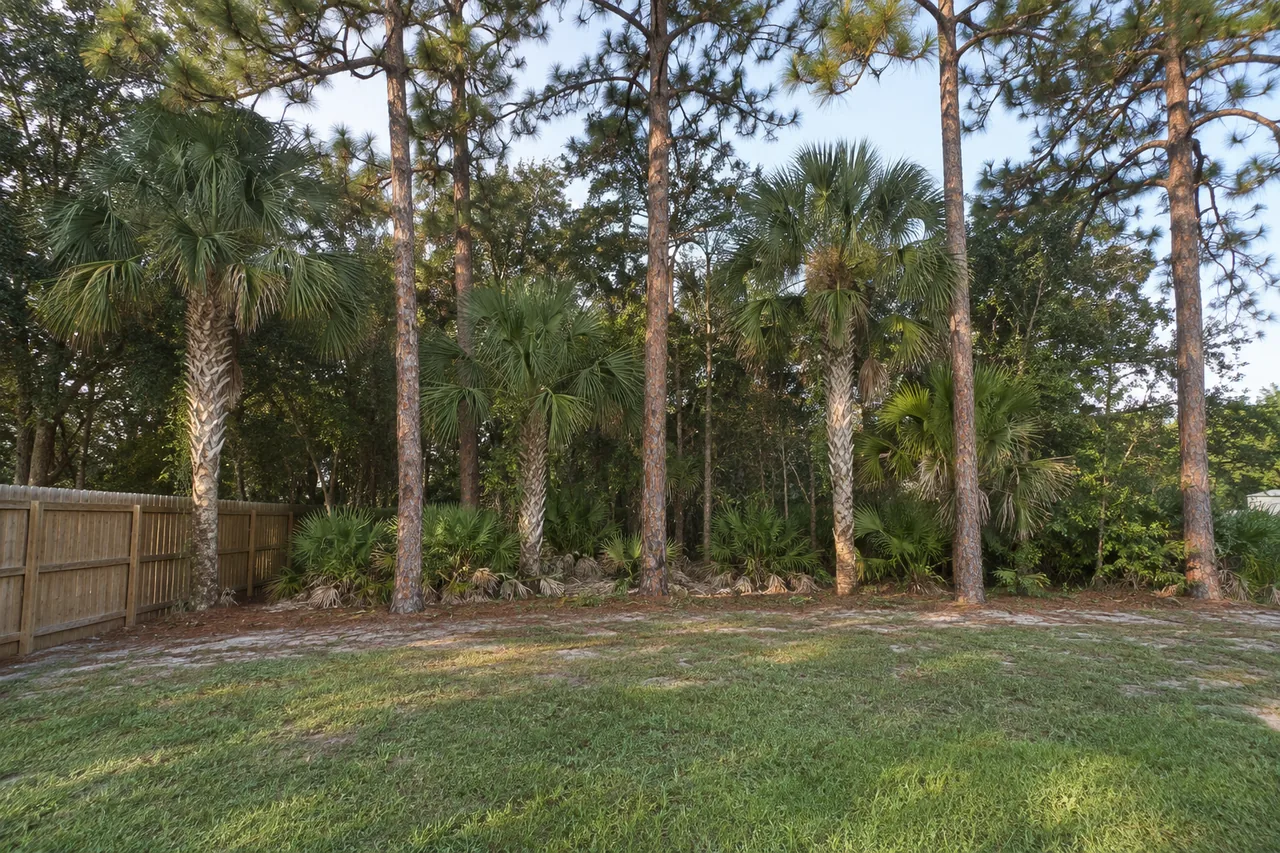
The cabbage palm, also called the sabal palm, rates at the top of UF/IFAS's tables: 99 percent of the experts surveyed rated its wind resistance high, and 92 to 93 percent were still standing after Jeanne, Charley and Andrew in the tropical survey (checked Nov 9, 2026). Leesburg's code lists it as a protected tree. Its threat is disease. UF/IFAS Gardening Solutions says lethal bronzing, a fatal and untreatable infection spread by a sap-feeding insect, kills cabbage palms and queen palms and has reached more than 30 of Florida's 67 counties (checked Nov 9, 2026).
The queen palm is the opposite case. FOR120 puts it in the lowest wind-resistance group, with just 42 percent standing after Hurricane Andrew in South Florida, and experts there rated it the weakest palm in wind. UF/IFAS lists it with a "caution" status, meaning it should be managed so it doesn't spread, rather than as invasive (checked Nov 9, 2026).
Slash and longleaf pine
Both native pines land in the medium-low group. In the surveys, 72 percent of slash pines and 59 percent of longleaf pines were standing after Ivan (checked Nov 9, 2026). The bigger threat often comes later. The Florida Forest Service's leaflet on pests after hurricanes says Ips engraver beetles and black turpentine beetles attack stressed pines and are likely to be more plentiful in the months and years after a storm, and its 2025 Forest Health Highlights report says engraver beetles helped kill pines in North Florida after Hurricanes Debby, Helene and Milton in 2024. Southern pine beetle was quiet by comparison: the report describes five small, slow-moving active spots in one area of Gadsden County in 2025, far to the northwest (all checked Nov 9, 2026). Signs of beetles are on dead or leaning trees.
Southern magnolia and crape myrtle
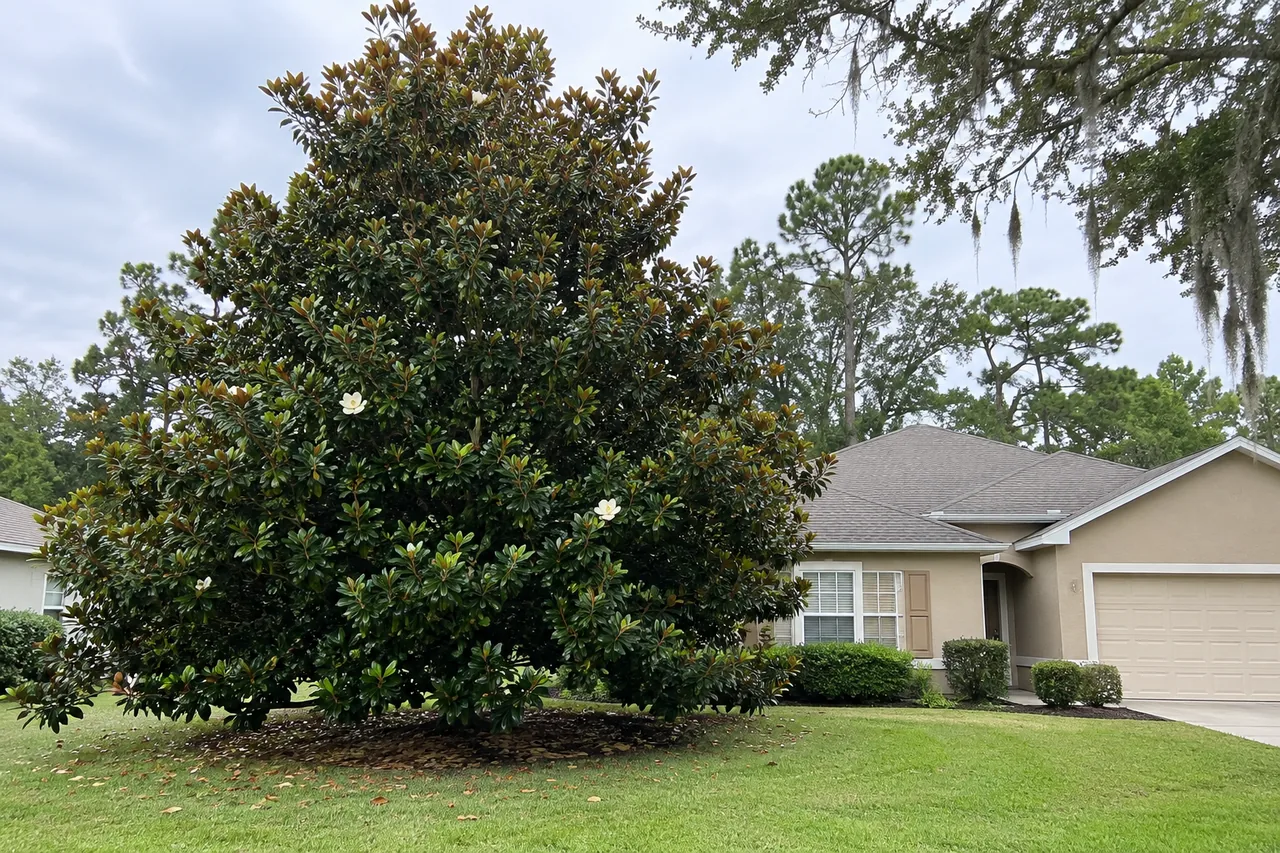
Both are in UF/IFAS's highest wind-resistance group. Southern magnolia, a native on Leesburg's protected list, had 92 percent standing after Ivan. Crape myrtle had 84 percent standing even though it lost about 88 percent of its leaves; the researchers found that losing leaves during a storm went along with better survival (FOR119, checked Nov 9, 2026).
Camphor: the one to take out
UF/IFAS Gardening Solutions says the UF/IFAS Assessment lists camphor as invasive in North and Central Florida and doesn't recommend planting it. Birds spread its shiny black berries, and in Central Florida it's crowding out the endangered Florida jujube. The page's advice to residents of North and Central Florida is to "remove it from your landscape" (checked Nov 9, 2026). Leesburg's code puts camphor on its prohibited tree list, so it isn't protected and can't count as a replacement tree. It can grow to about 70 feet with broad limbs, so a big one near the house is a removal job, not a weekend project.
Storms these trees have been through
- February 2, 2007. A tornado rated high-end EF-3 ran 16.5 miles from near Wildwood to east of Lady Lake before dawn. Lake County lost 21 people to that morning's tornadoes, and NWS Melbourne's survey found large trees stripped of their bark (survey statement of February 15, 2007; checked Nov 9, 2026).
- September 10–11, 2017, Hurricane Irma. Leesburg's airport recorded a 60-knot gust. An EF-1 tornado near Umatilla "uprooted numerous trees." Lake County's preliminary count listed 2,615 residential and 110 commercial buildings with damage, from minor effects to destroyed (NWS Melbourne report of September 29, 2017; checked Nov 9, 2026).
- September 2022, Hurricane Ian. Ten to 20 inches of rain fell across central and eastern Florida, and the National Hurricane Center's report lists Lake among the counties with flooding (report version of March 12, 2026; checked Nov 9, 2026).
- October 9–10, 2024, Hurricane Milton. NWS Melbourne's county summary reported gusts of 55 to 75 mph, 6 to 11 inches of rain, numerous downed trees and power lines, and 285 structures affected in Lake County, with about $13.6 million in losses (updated October 25, 2024; checked Nov 9, 2026).
Lightning
NWS Melbourne's lightning statistics rank Florida first in the nation for lightning deaths, with 449 people killed and 1,788 injured from 1959 through 2007. Lake County accounted for 13 of those deaths and 37 injuries. Most deaths came between May and September, and inland central Florida, around Orlando, sees 80 to 90 thunderstorm days a year (checked Nov 9, 2026). The NWS Miami office's 2026 lightning safety page says 3 of the 20 people killed by lightning in the United States in 2025 were in Florida, and that many victims are struck while sheltering under trees (checked Nov 9, 2026).
Lake County's tree rules treat trees killed or toppled by lightning, hurricanes and tornadoes like other dead trees: no replacement unless a development order requires it (checked Nov 9, 2026).
Choosing what to plant next
- From the high group. Live oak, southern magnolia, crape myrtle and cabbage palm all fared well in UF/IFAS's surveys. Live oak needs far more room than most lots offer.
- Away from the wires. SECO Energy's guidance is at least 15 feet from its lines for trees that stay under 25 feet, and 50 to 70 feet for trees that grow over 40 feet (checked Nov 9, 2026).
- Not camphor. It's on Leesburg's prohibited list and UF/IFAS calls it invasive in Central Florida.
- Think twice about queen palm. It's in the lowest wind group.
- Check replacement rules. If Leesburg requires replacement trees after a permitted removal, at least 75 percent must be canopy trees, and palms and pines count for no more than four inches each (Leesburg code, checked Nov 9, 2026).
Questions about local trees
Which tree in my yard is most likely to fail in a hurricane?
Among common Lake County yard trees, UF/IFAS puts laurel oak and queen palm in the lowest wind-resistance group. Condition matters as much as species, so an old, decayed tree of any kind is a concern.
Are cabbage palms really that tough?
In UF/IFAS's surveys, yes: 80 to 100 percent standing across storms, and nearly every expert rated them high (checked Nov 9, 2026). Lethal bronzing is the bigger danger to them.
Is it legal to cut down a camphor tree in Leesburg?
Leesburg's code lists camphor as a prohibited tree that isn't protected. Confirm with Planning and Zoning at 352-728-9760 if you're unsure of the species.
Should I worry about southern pine beetle?
The Florida Forest Service's 2025 report describes five small active spots in Gadsden County, in the Panhandle (checked Nov 9, 2026). Engraver beetles after storms were the larger pine problem in its report.
This site connects requests with one independent contractor who works in Lake County. Tree facts here come from the agencies named.
- UF/IFAS Extension, Selecting Coastal Plain Species for Wind Resistance (FOR119, revised August 2026) and Selecting Tropical and Subtropical Tree Species for Wind Resistance (FOR120, revised October 2026). Checked Nov 9, 2026.
- UF/IFAS Extension, Quercus virginiana: Live Oak (ENH-722) and Quercus laurifolia: Laurel Oak (ENH-707), revised December 2018. UF/IFAS Gardening Solutions, Lethal Bronzing Disease in Florida and Camphor Tree. Checked Nov 9, 2026.
- Florida Forest Service, Leaflet 23 (June 2019) and Forest Health Highlights 2025. Checked Nov 9, 2026.
- NWS Melbourne, Groundhog Day Tornado Outbreak survey (February 2007); Post Tropical Cyclone Report, Hurricane Irma (September 29, 2017); County Impacts Associated with Milton (updated October 25, 2024); Florida lightning statistics. National Hurricane Center, Tropical Cyclone Report, Hurricane Ian. NWS Miami, 2026 Lightning Awareness. Checked Nov 9, 2026.
- City of Leesburg Code of Ordinances Sec. 25-337.1. Lake County Tree Removal Permit Exemption form (revised 2019/12). SECO Energy, Vegetation Management. Checked Nov 9, 2026.