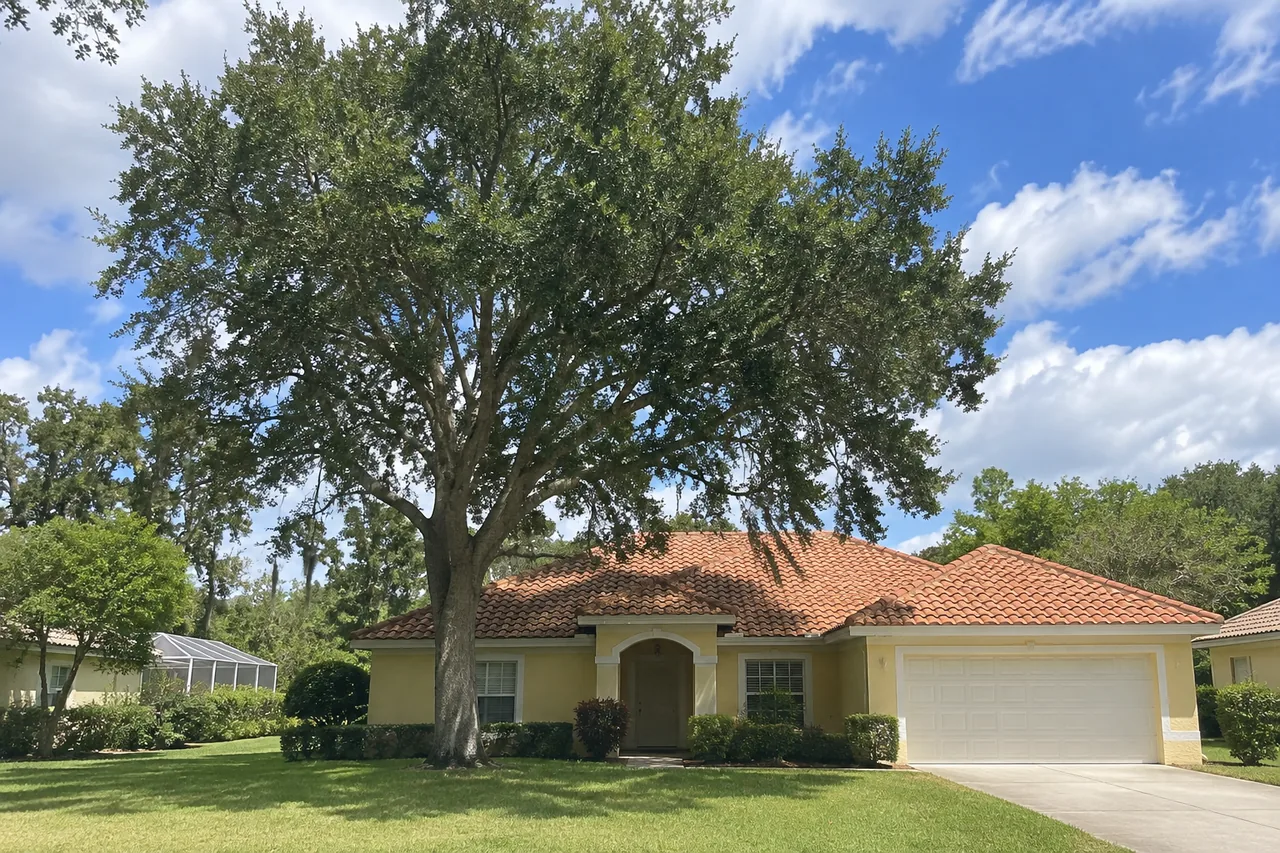
Laurel oak and live oak, side by side
The two trees share yards all over Lake County and are easy to lump together. The research treats them very differently. Figures below come from UF/IFAS Extension's fact sheets for each tree (ENH-707 and ENH-722, both revised December 2018) and its hurricane survey publication FOR119 (revised August 2026), all checked Nov 9, 2026.
| Trait | Laurel oak | Live oak |
|---|---|---|
| Height and spread | 60 to 70 feet tall, 35 to 45 feet wide | 60 to 80 feet tall, 60 to 120 feet wide |
| Life span | 50 to 70 years | Can be measured in centuries |
| Decay | Trunk and large limbs often hollow from rot | More resistant to decay |
| Wind-resistance group | Lowest | Highest |
| Still standing after Hurricane Ivan | 77% | 91% |
| Protected in Leesburg at | 4 inches across | 4 inches across |
The shape is the quickest field clue. A mature live oak can spread as wide as it is tall or wider, on curving limbs that droop; a laurel oak is much narrower for its height. If you aren't sure which you have, describe the tree in your request or send photos, and the contractor can tell you.
Laurel oak: a short life and hidden rot
The laurel oak fact sheet is unusually direct. It says the tree's trunks and large branches "often hollow from decay and wood rot," and that a small trunk injury or a poor pruning cut can start a column of decay running 10, 20 or more feet inside the trunk. It sets the life span at 50 to 70 years and notes that live oak and some other oaks resist decay better and live longer (checked Nov 9, 2026).
That matters because decay inside the trunk can't be seen from the yard. A laurel oak can carry a full, green crown while its center is hollow. In UF/IFAS's surveys after hurricanes, laurel oak was significantly less likely to be standing than live oak or sand live oak, and landed in the lowest wind-resistance group with water oak and sand pine (FOR119, checked Nov 9, 2026). A big laurel oak within reach of the house, past the age range in the fact sheet, deserves a hard look.
Live oak: reach, weight and Spanish moss
A live oak's risk is mostly about size and placement, not rot. UF/IFAS gives it "very good wind resistance" once established and puts it in the highest wind-resistance group, with 91 percent standing after Hurricane Ivan and 78 percent after Charley and Andrew (checked Nov 9, 2026). But a tree 60 to 120 feet wide sends long limbs over roofs, lanais and pool cages, and the fact sheet warns that stems and branches joined to the trunk at a narrow angle are likely to split.
Spanish moss hangs heaviest on live oaks. UF/IFAS Gardening Solutions says the moss doesn't kill trees and doesn't need to be removed, but that a heavy load can shade leaves, slow growth and help break branches, with little effect on a healthy tree (checked Nov 9, 2026). On a live oak, the usual answer to long, heavy limbs is pruning: shortening or removing the ones over the house, taking out deadwood, and correcting weak forks while the tree is young.
Bracket fungus and mushrooms
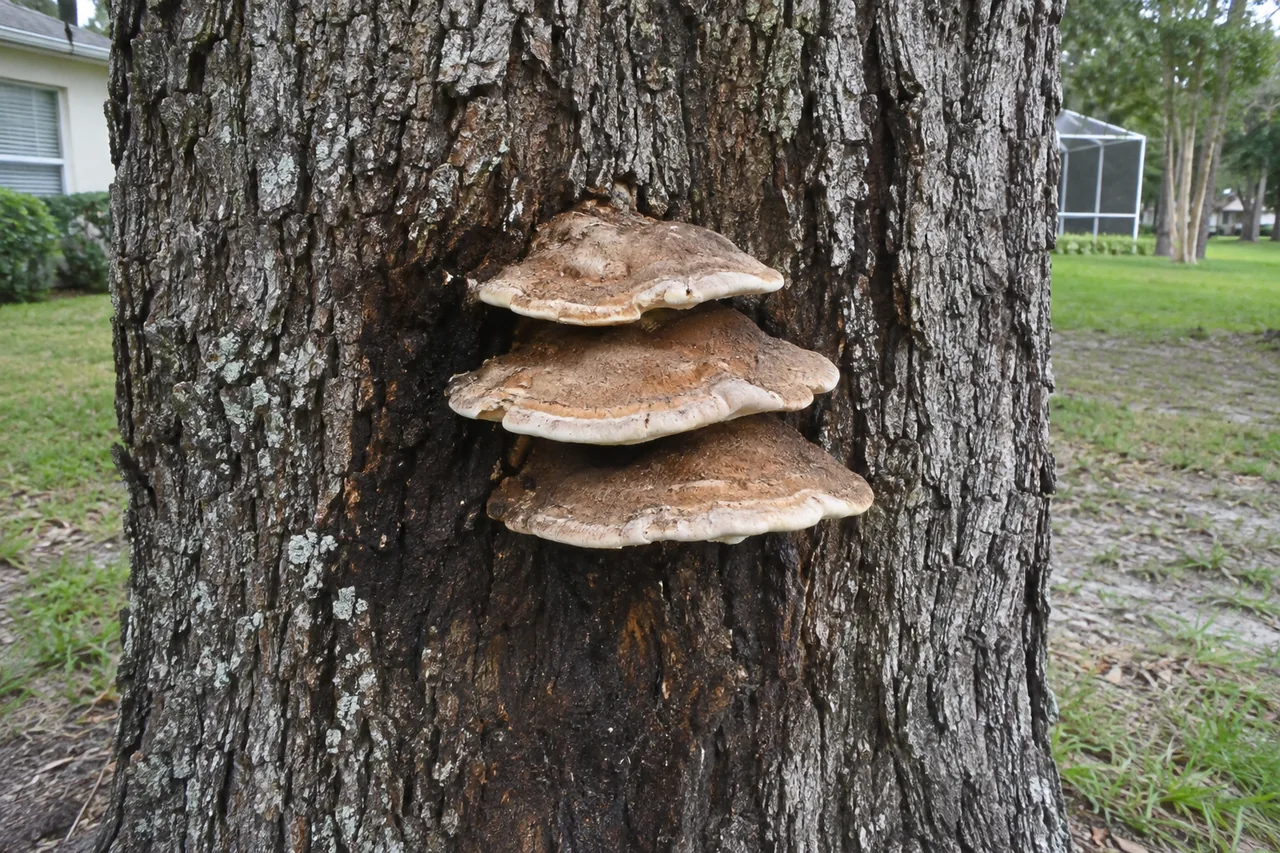
A shelf-shaped fungus growing from the trunk is a fruiting body, the visible part of a fungus living in the wood. UF/IFAS's "Is my tree safe?" (ENH1246) lists conks and other fungal fruiting bodies among the visible signs of decay, and shows mushrooms on laurel oak roots as a sign of root problems. The Florida Forest Service's leaflet on post-hurricane pests adds that several conks on one tree indicate extensive decay (both checked Nov 9, 2026).
The fungus itself isn't the hazard; the soft wood behind it is. One small conk high on a limb is a different situation from a ring of mushrooms around the base of a laurel oak leaning toward the house.
Roots near slabs, driveways and pools
UF/IFAS's live oak sheet says that in time they lift sidewalks, curbs and driveways, and it advises giving the tree plenty of room because the trunk can grow to more than six feet across. The laurel oak sheet says the base of the trunk flares out enough to lift sidewalks and curbing when the tree is planted in a strip less than eight feet wide (checked Nov 9, 2026).
Cutting roots to protect a slab or pool deck damages the root system, and ENH1246 lists pruned or broken root stubs at the soil surface among the visible signs of root problems. If an oak's roots are lifting a driveway or crowding a pool, the choice is often between removing the tree and accepting the concrete; cutting big roots close to the trunk can leave a tree standing that is less able to stay standing. Ask before anyone cuts large roots near the trunk.
Remove or prune?
There's no single rule, but the sources above point in a consistent direction:
- Removal usually makes sense for an older laurel oak near the house with a cavity, conks or mushrooms at the base, dieback at the top, or a lean that showed up after a storm; for any oak whose root plate has lifted; and for an oak whose roots have to be cut back hard near the trunk.
- Pruning usually makes sense for a healthy live oak whose limbs simply reach too far; for deadwood and broken limbs; and for young oaks that need their structure set early.
- An inspection makes sense when you can't tell, or when the tree is large, protected and close to the house. A big specimen oak is worth an inspection before anyone cuts it.
Oaks and Leesburg's permit
Both laurel oak and live oak are on the protected tree list in Leesburg's code, which covers native trees four inches or more across at breast height. The three-tree exemption is capped at 30 inches of combined trunk over three years, so a single big oak can use it up. A tree with a trunk 30 inches or more across qualifies as a specimen tree by size, and where replacement is required the code asks for 50 percent of a specimen tree's trunk inches, against 25 percent for other protected trees. A hazardous oak can come out under the photo-documentation exemption, and Florida Statute 163.045 removes local permits for a home's tree when the owner has documentation from an arborist or a landscape architect, as the statute describes (all checked Nov 9, 2026). Details are in the permits guide.
How a big oak comes down near a house
A wide oak over a roof or a pool cage usually comes down in pieces. A climber or a bucket truck removes the limbs, lowering anything above a structure on rope, and then the trunk is cut in sections from the top. Where a trunk leans over the house with no room to lower it, a crane may lift it out, if the ground, the drainfield and the wires allow one to set up. The tree removal guide covers the methods and the wood.
Worked example: a big live oak beside the house
Say the tree is a live oak with a trunk about 30 inches across at chest height and a canopy around 50 feet wide, partly over the roof, and you want the stump ground. Using Thumbtack's national tables (removal guide updated March 24, 2026; checked Nov 9, 2026):
- Removing the tree (24- to 36-inch trunk, canopy wider than 30 feet): $1,562 to $4,117.
- Grinding a 24- to 36-inch stump: $355 to $486.
- Together: $1,917 to $4,603, before any city permit fee or replacement trees.
Limbs over the roof that have to be roped down push a job toward the top of the range or past it. These are national averages, not Lake County prices; the contractor's written price is the real number.
Oak questions
My laurel oak is green and full. Can it still be rotten?
Yes. UF/IFAS says laurel oak trunks and large limbs often hollow from decay, and decay inside the trunk doesn't show in the leaves. Look for cavities, conks, mushrooms at the base and dead limbs at the top.
Does Spanish moss mean my oak is dying?
No. UF/IFAS says Spanish moss doesn't kill trees. A heavy load can shade leaves and help break branches, but a healthy oak copes with it.
Is a live oak safer than a laurel oak in a hurricane?
In UF/IFAS's surveys, yes: live oak is in the highest wind-resistance group and laurel oak in the lowest. Even so, 9 percent of the live oaks surveyed after Ivan weren't left standing (checked Nov 9, 2026), and a live oak's long limbs still need pruning.
Can I remove an oak in Leesburg without a permit?
Only under an exemption, such as the three-tree rule if the trunks total 30 inches or less over three years, the hazard exemption with photos, or the state law on documented dangerous trees (city code and state statute, checked Nov 9, 2026). Call Planning and Zoning at 352-728-9760 first.
This site sends oak requests to one independent contractor who works in Lake County. The site doesn't assess or cut trees.
- UF/IFAS Extension, Quercus laurifolia: Laurel Oak (ENH-707) and Quercus virginiana: Live Oak (ENH-722), both revised December 2018. Checked Nov 9, 2026.
- UF/IFAS Extension, Selecting Coastal Plain Species for Wind Resistance (FOR119, EDIS FR174; revised August 2026). Checked Nov 9, 2026.
- UF/IFAS Extension, "Is my tree safe?" (ENH1246, reviewed August 2018). UF/IFAS Gardening Solutions, Spanish Moss. Checked Nov 9, 2026.
- Florida Forest Service, Leaflet 23, Tree Pests and Diseases Following a Hurricane (June 2019). Checked Nov 9, 2026.
- City of Leesburg Code of Ordinances Sec. 25-337.1. Florida Statutes section 163.045, 2026 edition. Checked Nov 9, 2026.
- Thumbtack, cost to remove a tree, last updated March 24, 2026. Checked Nov 9, 2026.