
Inside Leesburg: the permit question
Leesburg's tree rules sit in Section 25-337.1 of its zoning code, "Tree protection." The section names as protected every tree and palm that is native to Florida or on the Florida-Friendly list once its trunk reaches four inches across at breast height, along with wetland trees of any size and historic, specimen and heritage trees. Live oak, laurel oak, cabbage palm, slash pine and southern magnolia are all on its list. The code says it is unlawful to "clear, kill or remove a protected tree or palm by any method without first obtaining a tree removal permit" (city code, checked Nov 9, 2026).
The same section lists exemptions. The ones a homeowner is most likely to use:
- Up to three trees. One to three trees whose trunks add up to no more than 30 inches, within any three-year period, as long as they aren't needed to meet a landscape requirement.
- Small trees. Anything under four inches across at breast height.
- Hazardous trees. A tree in a condition that endangers people. The owner photographs it before removal; if it had to come down at once, the code allows a letter and photos within 15 days.
- Trees on the prohibited list. Camphor, Chinese tallow, Brazilian pepper, chinaberry and a few others aren't protected at all.
The city's fee schedule lists the tree removal permit at $50 (checked Nov 9, 2026), and the homeowner permit form asks for the address and the reason, with boxes for hazards, poor health, utilities, access and use of the property. Where a permit is issued, the code asks for replacement trees equal to 25 percent of the removed trunk inches, or 50 percent for a specimen tree, and each tree cut without a needed permit counts as a separate violation. Call Planning and Zoning at 352-728-9760 before cutting anything you aren't sure about. The permits guide covers each rule in more depth.
Fruitland Park, Lady Lake and county land
Many Leesburg-area addresses are outside the city, and each place has its own approach (all checked Nov 9, 2026):
- Fruitland Park says tree removal requires a building permit through its Community Development Department. Its checklist asks for an aerial plan marking the trees to go with an X. Main line: (352) 360-6727.
- Lady Lake says a permit or an arborist report is required before removing trees inside town limits, and that invasive species can come out without one. Town Hall: 352-751-1501.
- Unincorporated Lake County, which takes in Okahumpka, Yalaha and the county roads, exempts a single-family lot of two acres or less with a house on it, as long as the trees the county's landscape code requires stay standing. County Planning: 352-343-9641.
If you live in a deed-restricted neighborhood, its own rules may ask for approval as well. Fruitland Park's checklist, for example, asks for any HOA or architectural review approval along with the application.
When the tree is a danger to the house
Florida Statute 163.045 gives homeowners a route around local permits for a dangerous tree. A city or county may not require a notice, application, permit, fee or replanting to prune or remove a tree on residential property when the owner has documentation that the tree poses an unacceptable risk to people or property. The documentation is an on-site assessment by an arborist or a landscape architect, as the statute describes, following a named tree risk assessment standard. Leesburg's own homeowner permit form cites the statute, and Lake County lists it among its exemptions (2026 Florida Statutes, checked Nov 9, 2026).
The statute covers a single-family detached home on a lot used as one. Keep the signed documentation with your records after the tree is gone.
How a big tree comes down next to a house
Picture a one-story block and stucco house with a screened lanai or pool enclosure at the back and a tile or shingle roof. A spreading oak beside a house like that rarely has a clear lane to fall in, so the method matters more than the saw.
- Felling in one piece. A notch on the side the trunk should fall toward and a back cut on the other. It needs open ground longer than the tree is tall. On a large lot near Okahumpka or Yalaha it may be possible; on a city lot it usually isn't.
- Piece by piece. A climber or a bucket truck takes the limbs first, then the trunk in short sections. Anything above the roof, the lanai or the pool cage is tied off and lowered on rope rather than dropped.
- With a crane. A big oak leaning over the house with no landing spot may be lifted out in sections. A crane needs firm footing, which sand, a drainfield or a pool deck can rule out, and room clear of overhead wires.
Ask which method the crew will use and where each piece lands. A useful answer names the drop zone and says what will protect the lawn, the screen panels and the pavers.
The logs, brush and chips
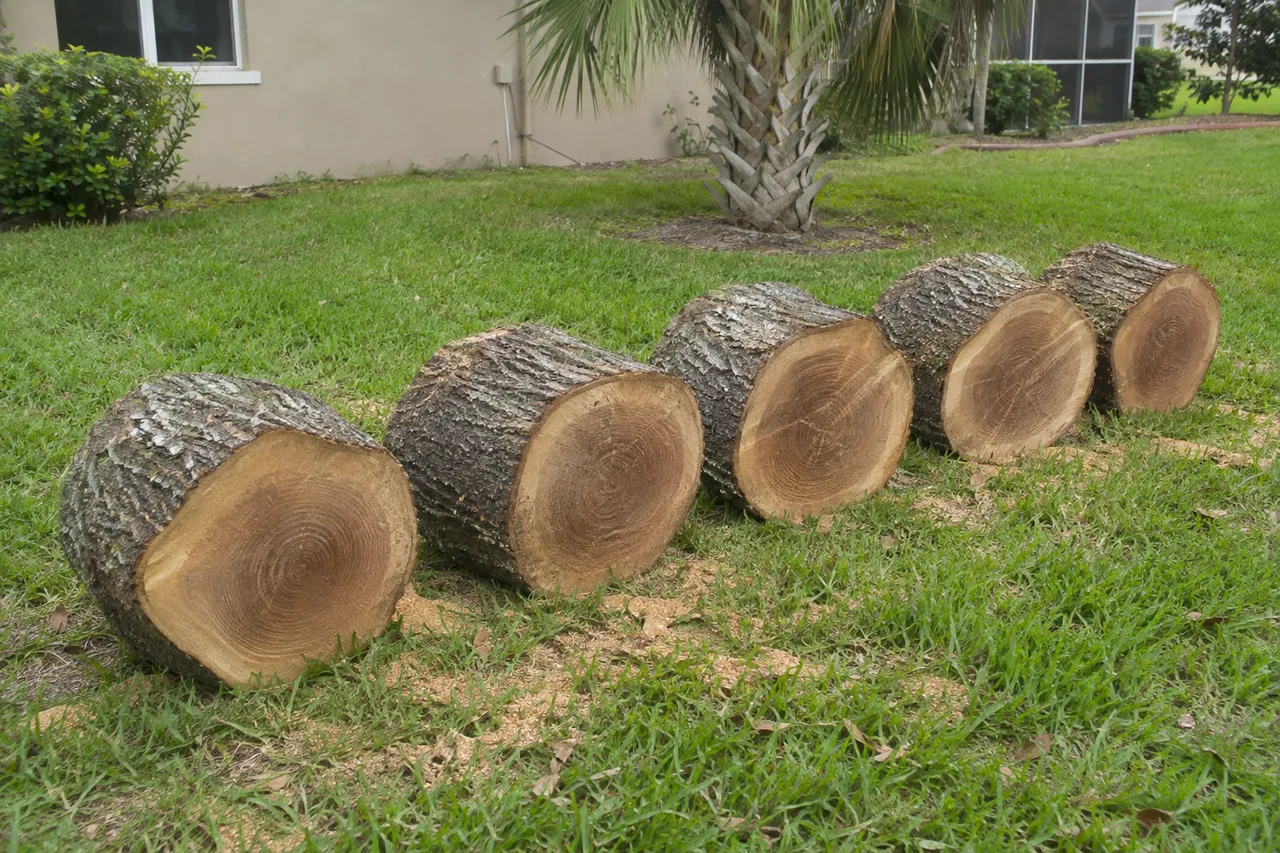
A full-grown oak leaves trunk sections, limbs as thick as a thigh, and a heap of brush. What happens to them depends on the address:
- Inside Leesburg. The city picks up yard waste on the second scheduled pickup day of each week, with limbs cut no longer than four feet and no thicker than six inches. Its garbage page also says contractors doing yard, landscaping or tree work "are responsible for removing all waste from the property" (checked Nov 9, 2026).
- Inside Fruitland Park. The city's yard waste page asks for limbs stacked no more than four feet long and under four inches thick, with bulk pieces such as stumps under 50 pounds; its tree permit checklist lists 6 feet and 6 inches instead, so confirm with the city (checked Nov 9, 2026).
- On county land. Plan on the brush being chipped, hauled off or burned under the state's rules.
The Florida Forest Service lets a homeowner burn yard waste without an authorization if it fits in a pile up to 8 feet across, meets the setbacks and no local rule bans it, lit after 9 a.m. and out an hour before sunset (checked Nov 9, 2026). Lake County has ordered countywide burn bans in dry spells. Get the cleanup in writing either way: all of it chipped and hauled, logs left in stove lengths, or chips left for the beds.
Wires and the service drop
Your electric bill shows which provider serves the house. Leesburg Electric's outage page says the city "owns the service wire and the electric meter only," and that the rest of the service riser on the house belongs to the homeowner (checked Nov 9, 2026). Duke Energy's tree FAQ says the property owner has the main duty to keep the pole-to-meter service line clear, that an unqualified person shouldn't work within 10 feet of overhead lines under 50,000 volts, and that it will de-energize the service line on request before tree work. SECO Energy says the same about service lines and offers a temporary disconnect before members trim near them (both checked Nov 9, 2026).
Mention any wires in your request. Work near a line changes who can do which part of the job and how long it takes.
The stump
Unless grinding is written into the price, expect the stump to stay. Grinding it digs into the ground, and Sunshine 811 says anyone digging must contact it at least two full business days before starting, not counting weekends, holidays or the day of the call (checked Nov 9, 2026). Sprinkler lines and other private pipes aren't marked by the utilities. More on stump grinding.
Where removals go wrong
- Cutting first, asking later. Inside Leesburg, a protected tree removed without a needed permit is a violation for each tree, and the code calls for replacement at a higher ratio.
- Counting trunk inches wrong. The three-tree exemption is capped at 30 inches combined over three years, so two big oaks can use it up.
- No landing plan. One section dropped through a screen enclosure costs far more than the extra rope work would have.
- Heavy equipment on soft ground. Sand after a week of rain, a drainfield or a pool deck can't always carry a loaded truck.
- Nothing written about the brush. Leesburg expects a tree crew to haul off its own debris, so a pile left at the curb may stay yours.
Published removal prices
Thumbtack's national guide, last updated March 24, 2026, puts the usual price to cut down and remove one tree at $450 to $1,450, and $884 to $1,627 with the stump taken out (checked Nov 9, 2026). It prices by trunk diameter and canopy width. Its smallest tier, a trunk under a foot thick with a crown narrower than 30 feet, costs $226 to $596; its largest, a 24- to 36-inch trunk with a crown past 30 feet, costs $1,562 to $4,117. They're national numbers, not Lake County prices. The table, a worked example and the local factors are on what tree work costs.
When removal isn't the right guide
A healthy live oak that only crowds the roof or the pool cage may just need a trim. A tree the storm already dropped belongs under storm and emergency removal. A tree that leans, sheds bark or grows mushrooms at the base fits dead or leaning trees. And if the tree is an oak and you're weighing whether to keep it, start with the oak guide.
Removal questions
Can I take down a palm without a permit in Leesburg?
Cabbage palms are on the city's protected list, so a cabbage palm four inches or more across counts like any protected tree (city code, checked Nov 9, 2026). For other palms, protection depends on whether the species is native or on the Florida-Friendly list, so ask Planning and Zoning if you aren't sure.
The tree is dead. Do I still need a permit?
Leesburg's exemption list says trees that died of natural causes or disease don't need replacing, and a tree endangering people falls under the hazard exemption with photos. Photograph it first and call Planning and Zoning at 352-728-9760.
Who files the permit, me or the contractor?
The city form is signed by the property owner. Agree in writing who fills it out and who pays the fee.
Can I keep the logs?
In most cases. Have the trunk bucked into firewood lengths and stacked where you want it. Less hauling can lower the price.
Requests sent from this site go to one independent contractor near Leesburg. The site itself removes no trees.
- City of Leesburg Code of Ordinances, Chapter 25, Article V, Sec. 25-337.1 Tree protection (read in the Zoneomics republication of the code); Planning and Zoning fee schedule; Tree Removal Permit form (2023). Checked Nov 9, 2026.
- Florida Statutes section 163.045, 2026 edition. Checked Nov 9, 2026.
- City of Fruitland Park, Trees page, tree removal checklist (revised 08-13-21) and Yard Waste page. Town of Lady Lake, Tree Removal Permits. Lake County Office of Planning and Zoning, Tree Removal Permit Exemption form (revised 2019/12). Checked Nov 9, 2026.
- City of Leesburg, Garbage page and Electric outages page. Florida Forest Service, "Know the Law" (DACS-P 00149). Checked Nov 9, 2026.
- Duke Energy, Trees and Rights-of-Way FAQ. SECO Energy, Vegetation Management. Sunshine 811, Homeowner page and FAQs. Checked Nov 9, 2026.
- Thumbtack, cost to remove a tree, last updated March 24, 2026. Checked Nov 9, 2026.