Decide what the trim is for
A trim with a clear purpose is easier to price and easier to judge when it's done. Most requests around Leesburg fall into one of these:
- Clearance. Limbs off the roof, the lanai screen, the driveway or the neighbor's side.
- Deadwood. Dead and broken branches out of the crown, especially the big ones high up.
- Structure. Shaping a younger tree so one strong trunk leads and the main limbs are spaced out.
- Storm preparation. Removing weak, split or hanging limbs before the wind season.
Say which one you want when you ask for a price, and ask the contractor to describe in writing which limbs will come off and roughly how much of the crown that is.
Shape young oaks early
UF/IFAS Extension's live oak fact sheet (ENH-722, revised December 2018) says a live oak can live for centuries if it's well placed and cared for, and calls it "not a plant-and-forget tree." Its pruning schedule: once a year for the first three years after planting, then every five years until the tree is about 30. It also advises removing stems and branches that meet the trunk at a narrow angle, because those are likely to split (checked Nov 9, 2026).
The laurel oak fact sheet (ENH-707, revised December 2018) stresses building a strong branch structure early, and warns that a small trunk wound or a poor pruning cut can start a column of decay inside the trunk 10, 20 or more feet long (checked Nov 9, 2026). Fewer, smaller cuts on a young tree are better than large cuts on an old one.
Where the cuts belong
The laurel oak sheet's advice on cuts is to prune on a regular schedule so that only small branches ever need to come off, and to keep each major limb thinner than half the trunk's diameter. Its decay warning shows why size matters: one poor cut on a big limb can let a column of rot start inside the trunk (checked Nov 9, 2026). Ask the contractor where the cuts will go and how thick the largest one will be.
Branch attachment is the other half. UF/IFAS's tree safety publication (ENH1246) says two stems of similar size joined in a sharp V are more likely to fail than a smooth U-shaped union, and that bark pinched inside the fork, called included bark, "significantly weakens" that joint (checked Nov 9, 2026). Weak forks are easiest to deal with while the tree is young and the stems are small.
Pruning and storm wind
UF/IFAS's guide to wind resistance in tropical and subtropical trees (FOR120, revised October 2026) calls pruning an important practice for a broadleaf tree's health and wind resistance, and reports that pruning gave trees more wind resistance (checked Nov 9, 2026). The pruning that UF/IFAS's fact sheets describe is structural: deadwood out, weak forks corrected while small, and big limbs kept in proportion to the trunk.
Two requests don't fit that description, so ask what they would accomplish before agreeing to them:
- Cutting the top off to make the tree shorter. Sawing through the main stems leaves large cuts high in the crown, the opposite of keeping cuts small.
- Stripping out the inside of the crown. Taking out most of the inner branches and leaving leaves only near the ends of long limbs isn't deadwood removal or fork correction.
If a tree is truly too big for its spot, ask about shortening limbs back to a smaller side branch rather than to a stub, or about removal.
Limbs over a pool cage, lanai or roof
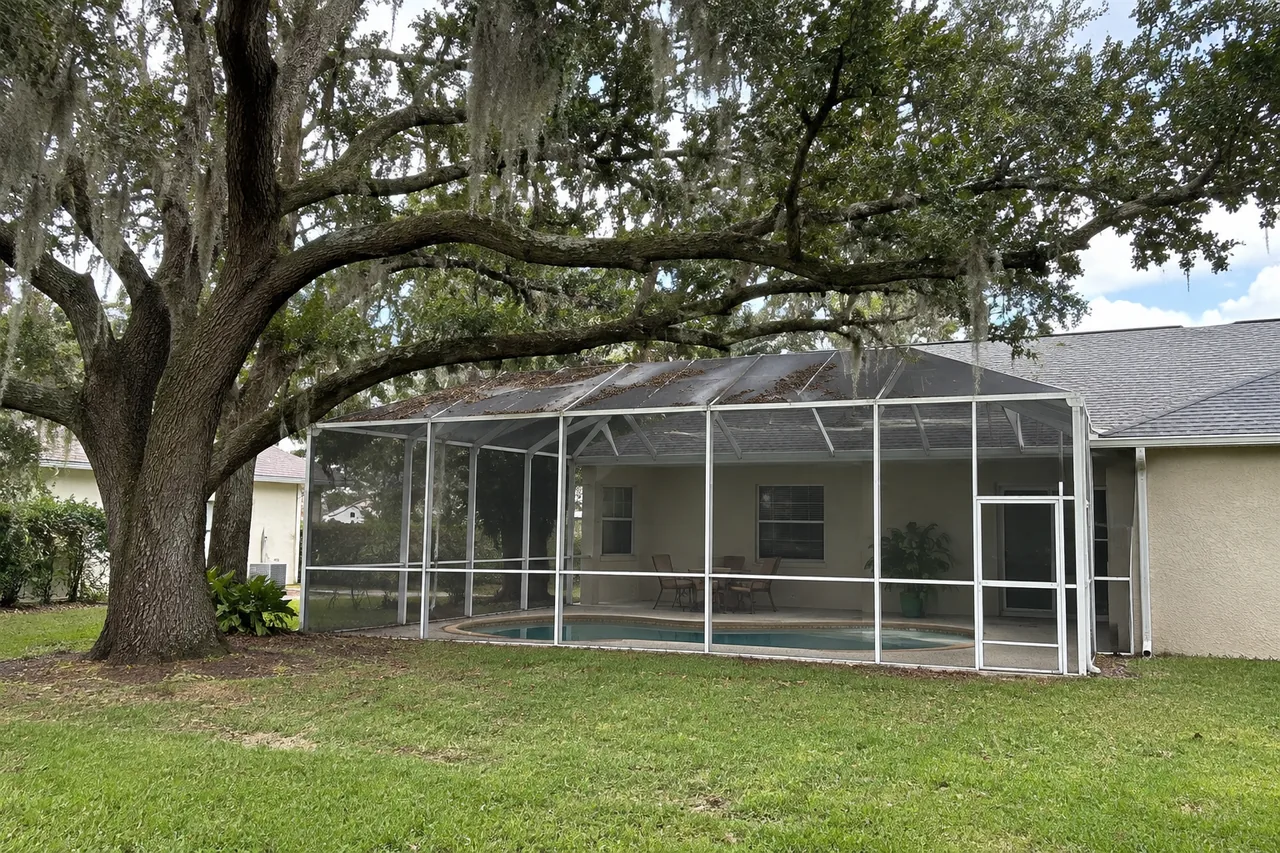
A falling limb can bend a screen enclosure's frame or tear its panels. Limbs above a cage or a tile roof are normally cut in short pieces and lowered on ropes from a climber or a bucket truck rather than dropped. Ask how the crew plans to protect the screen panels and the pool, and whether anything has to be moved out of the way.
Spanish moss often comes up in the same conversation. UF/IFAS Gardening Solutions says it doesn't kill trees and doesn't need to be removed, though a heavy load of it can shade leaves, slow growth and help break branches; on a healthy tree the effect is small (checked Nov 9, 2026). On a healthy tree, pulling moss off is mostly about looks; dead limbs hidden in it matter more.
The service wire to the house
Look at your electric bill. Leesburg Electric says it owns only the service wire and the meter, and that the rest of the service riser on the house is the homeowner's to repair. Duke Energy says the property owner has the main duty to keep the pole-to-meter service line clear of trees and will de-energize it on request before tree work. SECO Energy says pole-to-home service lines are the member's to keep clear, that it keeps a 10-foot clearance around its poles and main lines, and that it aims to prune every mile of its overhead lines every three years (all checked Nov 9, 2026).
Duke also says an unqualified person shouldn't work within 10 feet of overhead lines below 50,000 volts (checked Nov 9, 2026). Branches touching the main lines on the poles are the utility's job; call the provider rather than having anyone climb near them.
Does trimming need a permit?
Leesburg's tree protection section lists routine landscape maintenance among its exemptions, meaning trimming and pruning that isn't meant to kill the plant. Florida Statute 163.045 also covers pruning and trimming: a local government can't require a permit for it on a home lot when the owner has documentation from an arborist or a landscape architect, as the statute describes, that the tree poses an unacceptable risk (both checked Nov 9, 2026). Cutting so hard that a protected tree dies can still count as removing it, so keep the work to real pruning.
Published trimming prices
Thumbtack's tree trimming cost guide, last updated October 23, 2026, gives a national typical range of $402 to $1,158, with low-end jobs around $186 and high-end jobs around $2,456 (checked Nov 9, 2026). It prices by height:
| Height of the tree | National range |
|---|---|
| 5–10 ft. | $474–$848 |
| 11–20 ft. | $577–$993 |
| 21–40 ft. | $768–$1,362 |
| Taller than 40 ft. | $1,126–$1,957 |
A mature live oak can reach 60 to 80 feet tall with a spread of 60 to 120 feet, according to UF/IFAS, so a full crown cleaning on one sits at or beyond the top row. These are national averages, not Lake County prices. More on what tree work costs.
Trimming mistakes to avoid
- Waiting until a storm is forecast. Careful rope work over a roof or a pool cage takes time a storm watch doesn't leave.
- Paying for a shorter tree. Cutting through the main stems trades a lower crown for big wounds high in the tree.
- Waiting until limbs are huge. UF/IFAS favors regular pruning so only small branches come off; large cuts on old limbs invite decay.
- Leaving cut limbs on a curb in Leesburg. The city says tree contractors must remove their own waste, so hauling belongs in the price.
- Trimming near wires yourself. Ask the electric provider to disconnect the service line first, or leave that part to the crew.
When a trim won't fix it
A trunk with a cavity, bracket fungus or mushrooms at the base, or a tree that has started to lean, needs more than pruning; see dead or leaning trees. An old laurel oak over the house is its own decision, covered in the oak guide. And if the tree is simply in the wrong place, removal may cost less over time than trimming it every few years.
Trimming questions
How much of a tree can safely come off at once?
That depends on the tree's age, species and health, and on what the cuts are for. Ask the contractor to say in the written price roughly how much of the crown will be removed and why.
Should I have the Spanish moss pulled out?
UF/IFAS says it doesn't need to be removed and doesn't kill trees. If you want less of it for looks, ask about it separately from the structural work.
Will the electric company trim my tree?
Utilities trim around their own lines. The service wire to the house is generally the owner's to keep clear, according to Duke Energy and SECO Energy.
Do I need a city permit to trim a big oak in Leesburg?
Routine pruning that isn't meant to kill the tree is on the code's exemption list. Call Planning and Zoning at 352-728-9760 if the work is heavy.
This site sends each request to one independent contractor in the Leesburg area. It doesn't trim trees itself.
- UF/IFAS Extension, Quercus virginiana: Live Oak (ENH-722, revised December 2018); Quercus laurifolia: Laurel Oak (ENH-707, revised December 2018). Checked Nov 9, 2026.
- UF/IFAS Extension, "Is my tree safe?" (ENH1246, reviewed August 2018). Checked Nov 9, 2026.
- UF/IFAS Extension, Selecting Tropical and Subtropical Tree Species for Wind Resistance (FOR120, revised October 2026). UF/IFAS Gardening Solutions, Spanish Moss. Checked Nov 9, 2026.
- City of Leesburg, Electric outages page and Garbage page; Code of Ordinances Sec. 25-337.1. Duke Energy, Trees and Rights-of-Way FAQ. SECO Energy, Vegetation Management. Checked Nov 9, 2026.
- Florida Statutes section 163.045, 2026 edition. Thumbtack, 2026 Tree Trimming Cost Guide, last updated October 23, 2026. Checked Nov 9, 2026.